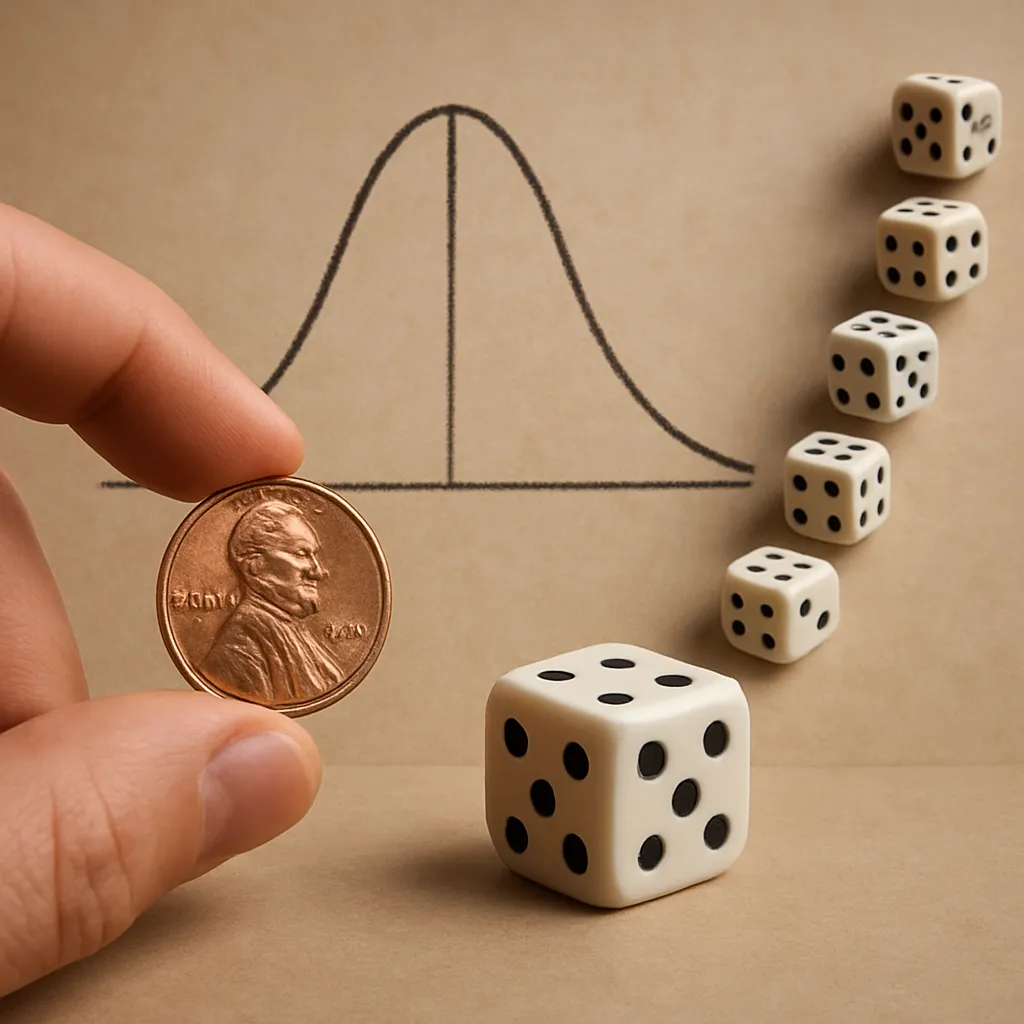
Coincidences often fascinate us, leading many to attribute them to fate or hidden forces. However, when examined through the lens of modern statistics and probability theory, most coincidences lose their mystical aura. By exploring the mechanics of random processes, the law of large numbers, and Bayesian reasoning, we gain insight into why unlikely events occur more often than intuition suggests.
Understanding the Nature of Coincidences
Defining Coincidences in Statistical Terms
A coincidence is usually described as two or more events happening together in a way that seems meaningful or surprising. From a statistical standpoint, a “coincidence” is simply an occurrence where random variables align in a specific pattern. What feels improbable to human perception can be quite ordinary when you evaluate all possible combinations.
Everyday Examples of Apparent Coincidences
- Meeting an old acquaintance in a foreign city
- Thinking of a song moments before it plays on the radio
- Buying a rare trading card just before its market value soars
- Experiencing repeated dreams about a number and then encountering it in real life
While these incidents feel extraordinary, they emerge naturally under randomness whenever sample sizes grow large.
The Role of Probability and Randomness
Random Events and Predictability
Random processes follow well-defined probability distributions, yet our intuition about them is often flawed. We tend to underestimate the variance inherent in random draws and overestimate how “balanced” or “fair” outcomes should be over short intervals.
Quantifying Improbable Events
Consider flipping a fair coin ten times. The probability of getting exactly ten heads is (1/2)10 ≈ 0.00098. That sounds small, but one hundred people each flipping coins ten times gives about a 9.5% chance that at least one person will get ten heads in a row. This illustrates how events with tiny individual probability become almost inevitable when repeated enough times.
- Single-event probability: Assessment of one outcome.
- Cumulative probability: Likelihood that an event occurs at least once in many trials.
- Independence: Key assumption that each trial does not affect others.
Law of Large Numbers and Unexpected Patterns
Why Rare Events Happen More Often Than Expected
The law of large numbers states that as the number of trials increases, the sample average converges to the expected value. However, before convergence settles, extreme deviations often appear more times than intuition allows. In a large enough dataset, every bizarre pattern you can imagine will appear somewhere.
Applications in Data Analysis
Data scientists meticulously control for multiple comparisons when assessing statistical significance, because thousands of simultaneous tests dramatically raise the chance of finding at least one “significant” result purely by luck. This is known as the multiple testing problem.
- Genome-wide association studies (GWAS): Millions of genetic markers yield many false positives without correction.
- Financial anomaly detection: Large volumes of market data produce spurious correlations.
- Machine learning hyperparameter search: Repeated experiments uncover rare but unrepeatable high-performing configurations.
Bayesian Perspectives on Coincidence
Updating Beliefs in Light of Evidence
Bayesian inference provides a framework to combine prior knowledge with observed data. If you hold a strong prior belief that the universe is random in nature, witnessing a striking coincidence does little to change that belief unless the event’s likelihood under randomness is vanishingly small.
Example: The Birthday Paradox Revisited
In a group of just 23 people, the chance that two share a birthday exceeds 50%. Even more surprising, for groups of 50, the probability jumps to over 97%. A Bayesian would start with a uniform prior on birthdays and update as each new person enters the group. The result challenges our intuitive sense of how birthdays distribute, reminding us that moderate-sized sets produce “unlikely” matches frequently.
Assessing Causality vs. Chance
When evaluating a supposed causal link behind a coincidence, Bayesian methods force explicit quantification of alternative explanations. This helps avoid the pitfall of post hoc reasoning:
- Prior odds: Initial belief in a causal mechanism.
- Likelihood ratio: How much more probable the data is under causation versus chance.
- Posterior probability: Updated belief after observing the coincidence.
Practical Takeaways for Statistical Thinking
Embrace Randomness and Expect Surprises
Rather than seeing every coincidence as evidence of special intervention, treat them as natural outcomes of probabilistic systems. Large datasets and repeated trials almost guarantee startling alignments.
Strategies to Avoid False Conclusions
- Account for multiple comparisons to reduce spurious findings.
- Use simulation methods (e.g., Monte Carlo) to estimate how often patterns emerge by chance.
- Apply Bayesian reasoning to balance surprising data against prior knowledge.
- Focus on effect sizes and reproducibility instead of isolated “significant” coincidences.
Final Thoughts
Coincidences will continue to capture our imagination, but with statistical tools, we can demystify the unexpected. Recognizing the power of randomness and applying rigorous probability principles transforms coincidences from mystical curiosities into teachable lessons about uncertainty and the structure of data.