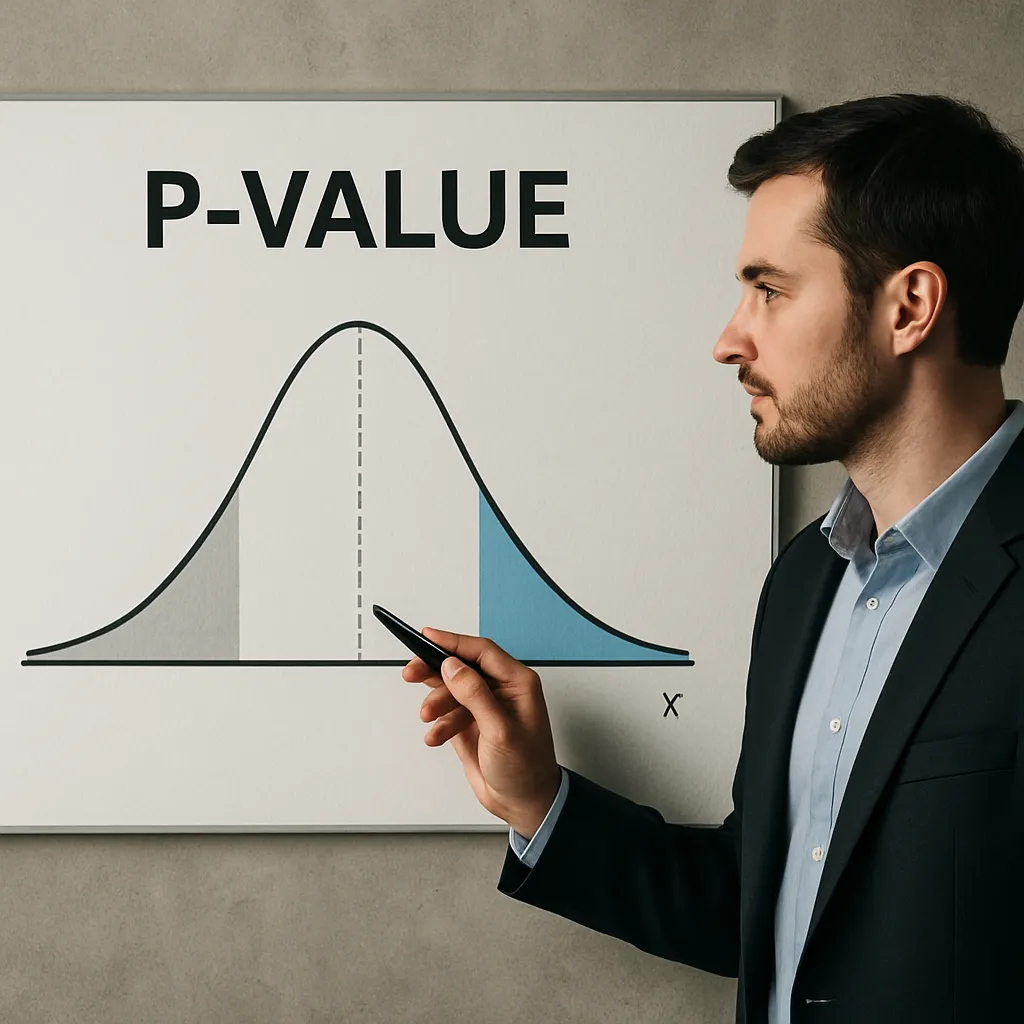
Effective interpretation of statistical results hinges on a clear grasp of what a p-value actually measures. Misunderstanding this concept can lead to misleading conclusions, wasted resources, and overconfidence in findings. This article unpacks the fundamental nature of p-values, highlights common mistakes, and offers guidance for more robust reporting in research.
Understanding the Concept of P-Values
Defining the P-Value
The p-value is often described as the probability of observing data at least as extreme as what has been collected, assuming that the null hypothesis is true. In formal terms, it quantifies how incompatible the observed results are with a presupposed model of no effect. It does not directly measure the truth of a hypothesis or the size of an effect, but rather the consistency between the data and the null model.
The Role in Hypothesis Testing
In standard frequentist frameworks, researchers set up two competing hypotheses: the null hypothesis (H₀), representing no effect or no difference, and the alternative hypothesis (H₁), representing the presence of an effect. The significance level (commonly denoted α) is chosen in advance—often at 0.05—and serves as a threshold for decision-making. If the computed p-value falls below α, the result is deemed “statistically significant,” suggesting that the observed data are unlikely under H₀.
- Type I error: Rejecting H₀ when it is in fact true. The probability of this error is controlled by α.
- Type II error: Failing to reject H₀ when H₁ is actually true. Its probability is influenced by sample size and effect size.
- Statistical power: The probability of correctly rejecting a false H₀, equal to 1 minus the Type II error rate.
Visualizing the P-Value
Imagine repeatedly sampling from a population where the null hypothesis holds. The p-value is the proportion of those hypothetical samples that would yield a test statistic at least as extreme as the one computed from the actual data. This perspective underscores its frequentist roots: p-values gain meaning through long-run frequencies of hypothetical replications, not through a single experiment alone.
Common Misconceptions and Pitfalls
P-Value as the Probability of the Null Hypothesis
A widespread error is interpreting the p-value as the probability that H₀ is true given the data. In reality, it’s the probability of the data given H₀, not the reverse. Conflating these probabilities is a logical fallacy known as the transposed conditional. P-values do not assign degrees of belief to hypotheses; they only measure data extremeness under a specific model.
Equating “Non-Significant” with “No Effect”
When a study yields a p-value above the chosen α, it might be tempting to conclude that there is no effect. However, failure to reach significance does not prove that the effect is absent. It may reflect insufficient statistical power due to small sample size or high variability. Null results should be interpreted cautiously, and confidence intervals can provide additional insight into plausible effect sizes.
Cherry-Picking and P-Hacking
Data analysts sometimes engage in questionable practices to achieve “significant” p-values. These include:
- Collecting more observations after inspecting initial results.
- Selective reporting of subsets of outcomes.
- Multiple testing without proper correction.
Such behaviors inflate the Type I error rate and undermine the reproducibility of scientific findings.
Best Practices in Reporting and Interpretation
Emphasizing Effect Sizes and Confidence Intervals
Instead of focusing exclusively on whether a p-value crosses an arbitrary threshold, researchers should report estimated effect sizes alongside confidence intervals. Confidence intervals communicate the range of values compatible with the data at a given confidence level, helping to illustrate both the magnitude and precision of an effect.
Adjusting for Multiple Comparisons
When multiple hypotheses are tested simultaneously, the chance of obtaining at least one spurious “significant” result rises. Correction methods such as Bonferroni, Holm, or false discovery rate (FDR) adjustments help maintain the overall error rate. Transparent reporting of all tests performed, significant or not, further helps readers assess the robustness of findings.
Promoting Transparency and Reproducibility
Pre-registration of study protocols and analysis plans discourages p-hacking by committing researchers to predefined hypotheses and methods. Sharing raw data and code enhances scrutiny and allows independent verification of results. Journals and funders increasingly encourage or require such open practices to strengthen the credibility of scientific evidence.
Complementary Statistical Approaches
To mitigate the limitations of null-hypothesis significance testing, researchers may consider:
- Bayesian analysis, which yields posterior probabilities of hypotheses given the data.
- Likelihood ratios, quantifying the relative support for competing models.
- Equivalence testing, designed to demonstrate that an effect is sufficiently small to be considered negligible.
Ethical and Practical Considerations
Avoiding Overemphasis on P-Values
While p-values can guide decision-making, they should not overshadow scientific reasoning. Contextual factors—such as study design quality, prior evidence, and theoretical plausibility—are equally vital. Overreliance on p-values may stifle innovation or produce a flood of low-quality studies chasing statistical significance.
Assessing Evidence in Context
Interpreting a p-value demands consideration of the broader research landscape. A single statistically significant result may carry little weight if numerous failed replications exist. Conversely, a borderline non-significant result may be persuasive if supported by strong prior knowledge and robust methodology.
Building a Culture of Critical Appraisal
Researchers, reviewers, and readers must cultivate a mindset that questions simplistic use of p-values. Emphasizing open dialogue about analytical choices and uncertainties fosters better science. Training in statistical literacy empowers stakeholders to differentiate between genuine discoveries and artifacts of analysis.