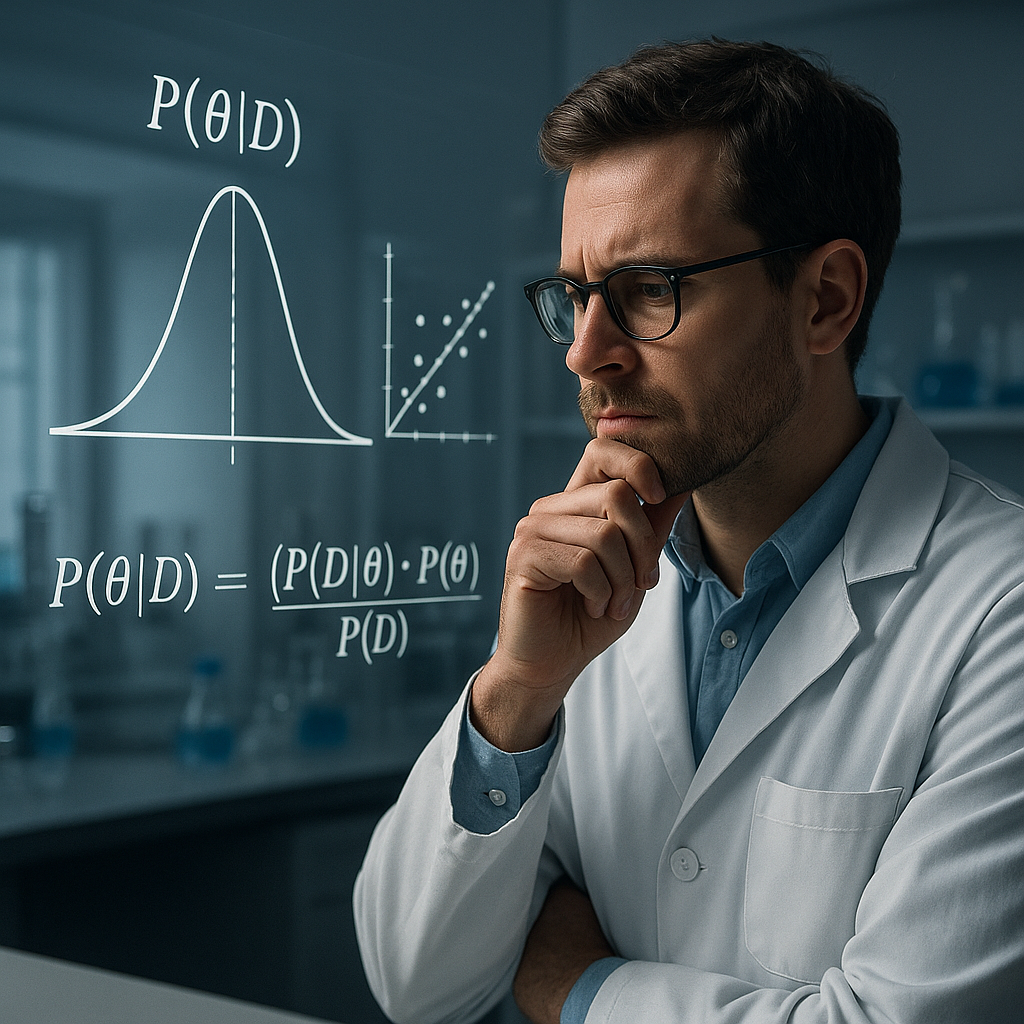
Bayesian thinking has emerged as a powerful framework that reshapes how researchers interpret data, weigh competing hypothesis, and make robust decisions. Embracing uncertainty as an integral component rather than a nuisance, it employs principles of probability to update beliefs in light of new evidence. By formalizing the shift from prior assumptions to posterior conclusions, Bayesian methods offer a flexible and coherent approach to inference across diverse scientific domains. This article explores the fundamental concepts, real-world applications, and future challenges of Bayesian reasoning in modern science.
Fundamental Concepts of Bayesian Thinking
Key Principles
At the heart of Bayesian analysis lies Bayes’ theorem, which states that the posterior probability of a model or parameter given the observed data is proportional to the product of the prior belief and the likelihood of the data under that model. Formally:
P(θ|D) ∝ P(D|θ) × P(θ)
Here, θ represents the unknown quantity of interest, and D denotes the observed data. The prior P(θ) encodes existing knowledge or assumptions, while the likelihood P(D|θ) measures how plausibly the data arise under different parameter values. The resulting posterior P(θ|D) integrates both sources, offering an updated degree of belief after seeing the data.
Mathematical Foundation
Bayesian methodology is grounded in model specification and probability calculus. Key elements include:
- Specification of a prior distribution reflecting historical information or expert judgment.
- Choice of a likelihood function based on an assumed data-generating process (for example, Gaussian, Poisson, or binomial models).
- Computation of the posterior distribution, which often requires advanced numerical techniques due to analytical intractability.
Modern implementations typically rely on algorithmic approximations such as Markov Chain Monte Carlo (MCMC), Variational Inference, or Sequential Monte Carlo. These approaches enable sampling or optimization in high‐dimensional spaces, turning abstract integrals into actionable estimates of posterior summaries (means, credible intervals, predictive checks).
Interpretation and Uncertainty
One of the most distinctive features of Bayesian analysis is its explicit treatment of uncertainty. Instead of yielding point estimates alone, the posterior distribution provides a full probabilistic description of parameter uncertainty. This nuance allows scientists to:
- Quantify the probability that a parameter lies within any specified range.
- Directly compare competing hypotheses by computing Bayes factors or posterior odds.
- Integrate over nuisance parameters rather than ignoring them, preserving valuable information.
Such transparency encourages robust conclusions and helps prevent overconfidence—a common pitfall in classical statistical methods.
Applications in Scientific Research
Machine Learning and Data Analysis
Bayesian techniques have permeated the field of machine learning, offering principled frameworks for regression, classification, and clustering. Examples include:
- Bayesian linear and logistic regression, where priors regularize coefficient estimates and mitigate overfitting.
- Gaussian processes, which model functions nonparametrically and deliver predictive distributions rather than pointwise predictions.
- Bayesian neural networks, which place priors on network weights to assess uncertainty and improve generalization.
In big-data contexts, scalable approximations such as stochastic variational inference facilitate the application of Bayesian methods to massive datasets. By providing calibrated uncertainty estimates, these models enhance decision-making in critical domains like healthcare diagnostics, autonomous systems, and financial forecasting.
Experimental Design and Hypothesis Testing
In many experimental sciences, from ecology to particle physics, researchers must decide how to allocate resources and which measurements to collect. Bayesian experimental design uses utility functions to optimize data collection strategies. By predicting the expected information gain or loss reduction from potential experiments, scientists can:
- Determine sample sizes adaptively, stopping data collection once sufficient evidence accumulates.
- Select stimuli or treatment levels that maximize the probability of distinguishing between competing models.
- Incorporate sequential analysis, updating posterior beliefs as data arrive and refining experimental protocols in real time.
Such an adaptive approach contrasts sharply with fixed-sample designs, offering efficiency gains and ethical benefits in fields like clinical trials.
Ecology, Epidemiology, and Beyond
Bayesian frameworks have become indispensable in complex systems modeling. For instance:
- In ecology, hierarchical Bayesian models estimate population dynamics under observation noise and environmental variability.
- In epidemiology, spatial-temporal Bayesian models capture disease spread patterns, integrating surveillance data with demographic factors.
- In astronomy, Bayesian inference helps infer celestial object properties from noisy observations, enabling discoveries of exoplanets and dark matter signatures.
By accommodating multilevel structures and missing data, the Bayesian approach offers unparalleled flexibility for interpreting real-world phenomena.
Challenges and Future Directions
Computational Demands
Despite its conceptual elegance, Bayesian analysis can be computationally intensive. High-dimensional integrals and complex likelihood surfaces may require substantial processing power. Addressing this challenge involves:
- Developing more efficient sampling algorithms (e.g., Hamiltonian Monte Carlo, slice sampling).
- Leveraging parallel computing architectures and GPU acceleration.
- Exploring approximate inference techniques that balance speed and accuracy.
Ongoing research seeks to reduce computational burdens while preserving the fidelity of uncertainty quantification.
Integration with Non-Bayesian Methods
Pragmatic data science often blends Bayesian and frequentist perspectives to exploit the strengths of each. Hybrid approaches include:
- Empirical Bayes, where hyperparameters of the prior are estimated from the data.
- Bootstrap-based methods for approximating posterior summaries without full Bayesian machinery.
- Penalized likelihood approaches that mirror Bayesian regularization via prior-inspired penalties.
Such combinations foster practical solutions in contexts where pure Bayesian implementation may be prohibitive or where classical methods dominate established workflows.
Emerging Trends
Looking ahead, several frontiers promise to expand the impact of Bayesian thinking:
- Automated model building and discovery, driven by probabilistic programming languages that lower the barrier to complex specification.
- Integration with deep learning, yielding interpretable architectures that quantify uncertainty in predictions.
- Real-time Bayesian updating for streaming data in IoT applications, enabling adaptive control and anomaly detection.
By uniting theoretical advances with computational innovations, Bayesian reasoning is set to remain a cornerstone of modern science, guiding robust inference and informed decision-making across disciplines.